High-stress professionals are often praised for being reliable, steady, and strong. They are the people others count on when pressure builds, deadlines tighten, responsibilities multiply, or problems need to be solved quickly. Whether someone works in healthcare, public service, education, construction, leadership, emergency response, transportation, manufacturing, administration, or another demanding field, the expectation is often the same: keep going, stay composed, and get the job done.
But being strong does not mean carrying everything alone.
At Healing Minds, we often meet people who have spent years pushing through stress without giving themselves permission to slow down, reflect, or ask for support. Many are hardworking adults who take pride in providing for their families, showing up for their teams, and doing their best even when life feels overwhelming. They may not see themselves as someone who “needs therapy.” They may tell themselves that stress is just part of the job, that other people have it worse, or that they should be able to handle things on their own.
Over time, though, constant pressure can affect more than your mood. It can impact your sleep, patience, relationships, concentration, physical health, and ability to feel present in your own life. Therapy offers a place to step out of survival mode and begin building practical tools for emotional resilience, stress relief, and healthier connection.
Resilience is not about being unbreakable. It is about knowing how to recover, regulate, communicate, and receive support before stress becomes too heavy to manage.
Why High-Stress Professionals Often Wait Too Long to Get Support
Many high-stress professionals are used to functioning under pressure. They are often capable, responsible, and solution-focused. These strengths can help them succeed at work, but they can also make it harder to recognize when stress is becoming unsustainable.
People in demanding jobs may normalize chronic stress because they are surrounded by others who are also overwhelmed. When everyone is tired, tense, or stretched thin, burnout can start to feel like the standard. A person may begin to believe that exhaustion, irritability, poor sleep, or emotional numbness is just “how life is.”
There is also the pressure of identity. Many professionals see themselves as dependable. They may be the person their family turns to, the person coworkers rely on, or the person who keeps things moving when others are struggling. Asking for help can feel uncomfortable because it may seem to conflict with the role they have always played.
For some, therapy may feel like something reserved for a crisis. But therapy is not only for moments when everything has fallen apart. In fact, many people benefit most when they begin therapy before stress reaches a breaking point. Therapy can help you understand what is happening internally, identify patterns, and create realistic strategies for managing pressure in a healthier way.
Getting support is not a sign that you are failing. It is a sign that you are paying attention.
The Hidden Cost of Constant Stress
Stress is not always obvious at first. It can build gradually, especially for people who are used to pushing forward. You may still be going to work, taking care of your family, paying bills, and meeting responsibilities. On the outside, everything may appear fine. Internally, though, stress may be taking a toll.
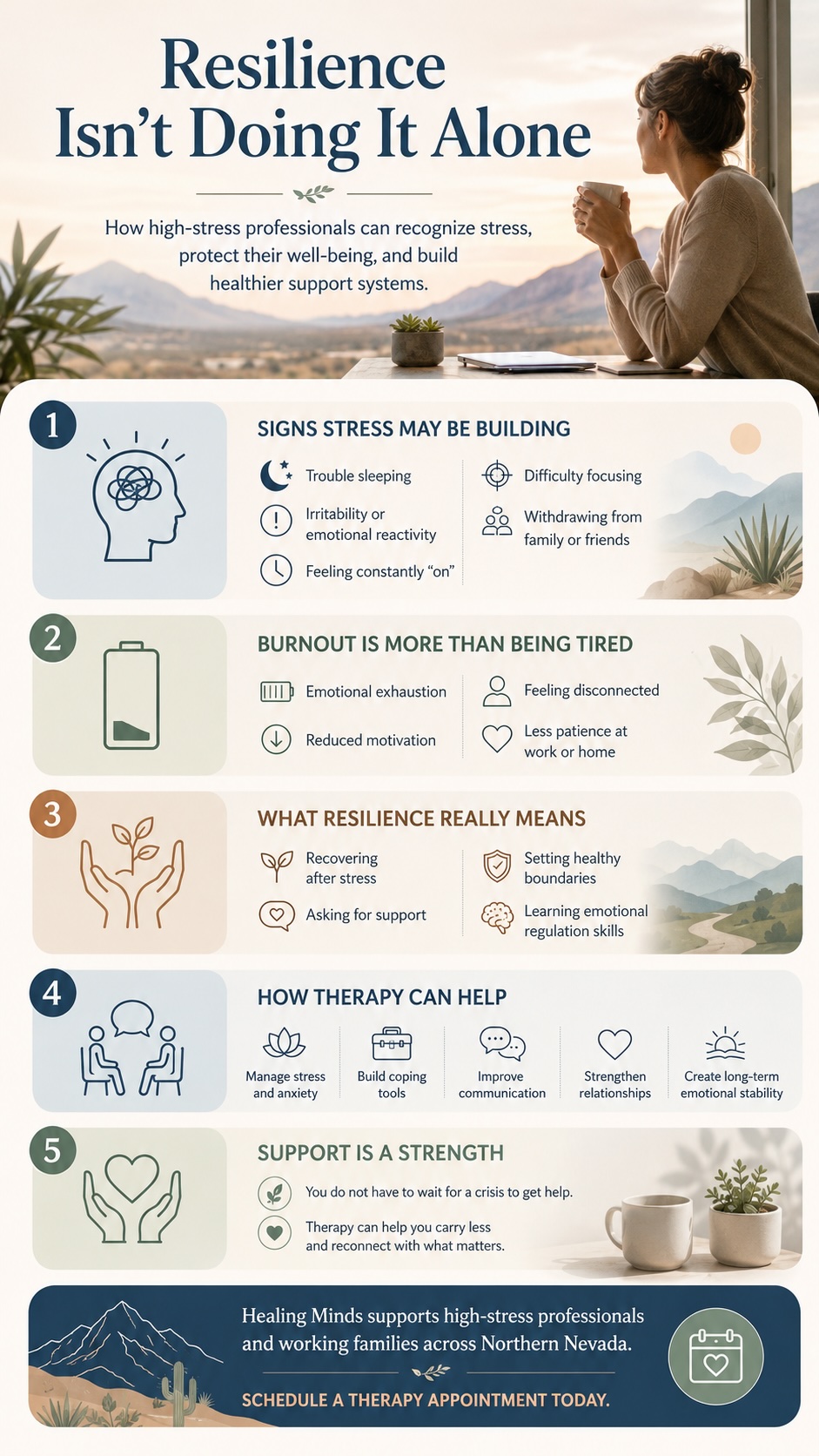
Common signs of chronic stress include difficulty sleeping, waking up tired, feeling tense or on edge, snapping at loved ones, withdrawing from family or friends, racing thoughts, trouble focusing, headaches, stomach issues, low motivation, emotional numbness, or feeling like you cannot fully relax even when you have time off.
Many people also notice changes in their relationships. Stress can make it harder to be patient, affectionate, or emotionally available. Conversations with a partner may become shorter or more reactive. Parenting may feel more difficult. Small problems may feel bigger than they used to. You may find yourself wanting quiet but feeling guilty for needing space.
Chronic stress can also affect how you see yourself. You may become more self-critical, less confident, or more easily discouraged. Tasks that once felt manageable may begin to feel overwhelming. You may feel like you are always behind, always needed, or always bracing for the next demand.
These reactions are not character flaws. They are signals. Your mind and body may be telling you that your current coping system needs more support.
Burnout Is More Than Being Tired
Burnout is often misunderstood as simple exhaustion. While fatigue is a major part of it, burnout usually runs deeper. It can include emotional depletion, cynicism, reduced motivation, irritability, detachment, and a sense that your effort no longer makes a meaningful difference.
For high-stress professionals, burnout can be especially difficult because the responsibilities do not stop. People may continue working while feeling internally disconnected. They may become less patient with clients, coworkers, patients, customers, students, or family members. They may feel guilty for not caring as much as they used to, even though the issue is not a lack of compassion or commitment. It is depletion.
Burnout can also follow people home. After a demanding day, you may not have much left to give to your partner, children, friends, or yourself. You may find yourself zoning out, scrolling your phone, avoiding conversation, or feeling irritated by normal household needs. Even rest may not feel restorative because your nervous system remains activated.
Therapy can help you identify burnout patterns and begin making changes that are both practical and emotionally meaningful. This does not always mean making a major career change. Sometimes it means improving boundaries, learning emotional regulation skills, addressing perfectionism, processing difficult experiences, improving communication, and rebuilding a healthier relationship with responsibility.
Emotional Regulation: A Practical Skill for Stressful Work and Home Life
One of the most valuable benefits of therapy for high-stress professionals is learning emotional regulation. Emotional regulation does not mean suppressing feelings or pretending everything is fine. It means learning how to notice what is happening inside you, understand your reactions, and respond with more intention.
When stress is high, the nervous system can become reactive. You may move quickly into fight, flight, freeze, or shutdown responses. Fight may look like anger, defensiveness, or sharp communication. Flight may look like overworking, avoiding conflict, or staying constantly busy. Freeze may look like feeling stuck, overwhelmed, or unable to make decisions. Shutdown may look like numbness, withdrawal, or disconnection.
These responses are human. They are not signs of weakness. But when they become your default, they can create problems at work and at home.
In therapy, you can learn to recognize early warning signs before stress takes over. You may practice grounding skills, breathing techniques, thought reframing, communication tools, and ways to calm your body after intense experiences. Over time, these skills can help you feel more in control of your responses, even when life remains demanding.
For many people, emotional regulation also improves relationships. When you can pause before reacting, name what you need, and communicate more clearly, conflict often becomes less intense. You may still experience stress, but it does not have to control every interaction.
The Family Impact of High-Stress Work
Work stress rarely stays at work. It often enters the home through mood, energy, communication, and availability. Many high-stress professionals care deeply about their families but feel frustrated that they are not showing up the way they want to.
You may love your family and still feel overwhelmed by their needs. You may want connection but feel too drained to engage. You may want to be patient but find yourself reacting quickly. You may want to be present but feel mentally stuck on work problems long after the day has ended.
This can create guilt. Many people tell themselves, “I should be able to handle this better,” or “My family deserves more from me.” While those feelings are understandable, guilt alone rarely creates lasting change. Support, insight, and practical tools are often more effective.
Therapy can help you explore how stress is affecting your relationships and identify realistic ways to reconnect. This might include learning how to transition from work mode to home mode, setting boundaries around work-related communication, improving conflict patterns, or talking with loved ones about stress without placing the burden on them to fix it.
For couples, therapy can help partners understand the stress cycle rather than blaming each other for it. For parents, therapy can support more intentional responses to children and teens. For individuals, therapy can provide space to process the pressure of being needed by many people at once.
Healing often begins with understanding the system you are living in, not blaming yourself for struggling within it.
Resilience Is Built Through Support, Not Isolation
There is a common belief that resilience means handling hardship alone. In reality, isolation often makes stress heavier. Human beings are built for connection, reflection, and support. Even the most capable people need spaces where they do not have to perform, lead, fix, or carry everything.
Therapy offers a confidential relationship focused on your well-being. It is a space where you can be honest about what feels hard without worrying that you are burdening your family, disappointing your coworkers, or losing your image as the dependable one.
In therapy, resilience may look like learning to ask for help sooner. It may look like understanding your limits without shame. It may look like creating boundaries that protect your health. It may look like becoming more aware of your emotions instead of ignoring them until they become unmanageable. It may look like reconnecting with parts of yourself that have been pushed aside by stress.
Resilience is not a personality trait that some people have and others do not. It is something that can be developed. But it is developed through care, practice, and support—not constant self-pressure.
When Stress Becomes Anxiety
For some high-stress professionals, ongoing pressure develops into anxiety. Anxiety may show up as constant worry, racing thoughts, tension, restlessness, difficulty sleeping, irritability, or a sense that something bad is about to happen. It may also involve overplanning, overchecking, or feeling unable to relax.
Anxiety can be especially frustrating for people who are used to being practical and capable. They may know logically that they are safe, prepared, or doing their best, but their body still feels activated. This disconnect can lead to self-criticism: “Why can’t I just calm down?”
Therapy can help bridge the gap between what you know logically and what your nervous system is experiencing physically. Through evidence-informed approaches, you can learn to identify anxious thought patterns, reduce avoidance, calm physiological symptoms, and build confidence in your ability to handle uncertainty.
Anxiety is not something you have to simply endure. With the right support, it can become more understandable and manageable.
The Role of Boundaries in Burnout Recovery
Boundaries are often discussed as if they are simple, but for many high-stress professionals, they are complicated. You may work in an environment where demands are constant. You may worry that saying no will let others down, create conflict, or make you appear less committed. You may also have family responsibilities that make personal time feel unrealistic.
Healthy boundaries do not mean neglecting responsibilities. They mean creating sustainable limits so you can continue showing up without losing yourself.
In therapy, boundary work may involve identifying where your energy is going, clarifying what is within your control, practicing direct communication, and addressing the guilt that often comes with change. Boundaries may be external, such as limiting after-hours work communication when possible, or internal, such as learning not to mentally replay work problems all evening.
Small boundaries can create meaningful relief. A five-minute transition before entering the house, a clearer conversation with a supervisor, a planned moment of quiet after work, or a more honest conversation with a partner can begin to shift the pattern.
Burnout recovery often requires more than rest. It requires a new relationship with responsibility.
Therapy as a Tool for Long-Term Stability
Many people begin therapy because something feels urgent: stress, anxiety, conflict, burnout, grief, or emotional overwhelm. But therapy can also become a tool for long-term stability. It helps you build self-awareness, strengthen coping skills, and make decisions from a grounded place rather than a reactive one.
For high-stress professionals, therapy can support many goals, including reducing stress symptoms, improving sleep habits, managing anxiety, strengthening communication, navigating workplace pressure, addressing trauma exposure, improving family relationships, increasing self-compassion, and creating a healthier work-life balance.
Therapy is not about changing who you are. It is about helping you function with more clarity, steadiness, and connection. Many of the traits that make high-stress professionals effective—dedication, responsibility, persistence, and care for others—are strengths. The goal is not to remove those strengths. The goal is to support them with healthier coping tools so they do not become a pathway to exhaustion.
Why Local Support Matters
For individuals and families in Northern Nevada, finding the right therapist is about more than convenience. It is about trust, fit, and understanding the local community. Healing Minds serves people throughout Reno, Sparks, Carson City, Fallon, and surrounding rural communities, with in-person therapy available in Reno and telehealth options across Northern Nevada.
Local care matters because stress is shaped by real-life context: work culture, family responsibilities, access to services, commute demands, financial pressure, and community expectations. Many working adults in Northern Nevada are looking for therapy that feels practical, professional, and grounded—not overly clinical or disconnected from everyday life.
Healing Minds provides compassionate, relationship-centered therapy rooted in clinical excellence. That means we care not only about symptom relief, but also about the relationships, responsibilities, and values that shape your life.
Taking the First Step
If you are a high-stress professional, you may be used to waiting until things are truly unmanageable before seeking support. But you do not have to wait for a crisis. Therapy can help you understand what stress is doing to your mind, body, and relationships—and help you build a more sustainable way forward.
You deserve support before you are completely burned out. You deserve a place to talk honestly, learn practical tools, and reconnect with the parts of life that matter most. You deserve care that respects your strength while helping you carry less alone.
Resilience is not doing everything by yourself. Resilience is knowing when to reach for support, when to slow down, and when to build new tools for the life you are working so hard to maintain.
At Healing Minds, we support high-stress professionals and working families across Northern Nevada with therapy that is compassionate, professional, and focused on long-term emotional well-being.
Ready to take the next step? Schedule a therapy appointment with Healing Minds and begin building resilience with support that meets you where you are.